How do we evaluate User Experience (UX)?
What is User Experience?
User Experience is a user or viewer’s experience with an application (web site, mobile app, blog, e-commerce store, etc.).
What is the problem with User Experience?
User Experience is quite difficult to classify. As software designers, we talk around UX all the time. We constantly explore the boundaries of substantive feedback and criticism with our peers.
Who is the User Experience designer?
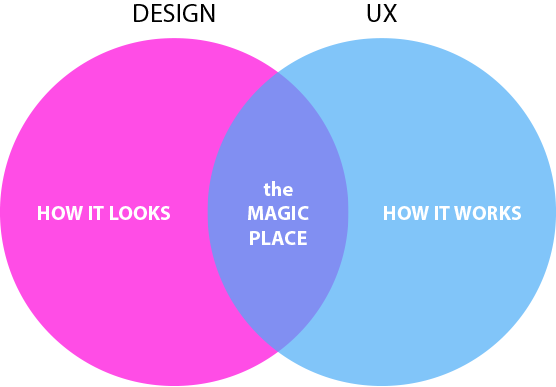
User Experience (UX) design is a largely misunderstood pursuit. It lies somewhere between the User Interface (UI) design and the end application user. The key difference between UX and UI is that the #1 concern of the User Experience designer is ‘how it works.’ The #1 concern of the User Interface designer is ‘how it looks.’ While there is surely a large overlapping ven diagram between the two disciplines, it is very important to distinguish that the UX designer will always compromise the art of visual composition in favor of pure USABILITY.
EMPATHY is the most important characteristic of a great software designer. There are surely other important qualities like creativity, contrast control, color control, visual hierarchy, deconstructive nature and intuition.
Can a visitor easily and intuitively use an application? Furthermore, can ALL visitors easily use an application, including those who are a bit older, those with large fingers, those with degraded vision, those with poor monitor contrast, those who do not respond quickly to icons, etc?
Can we propose a set of criteria to evaluate a software application? Many times our teams have gathered around a conference table or monitor, with no real substantive feedback or critique other than personal preference like “I don’t like green” or “Add a modal, add a shadow” or “I hate that font”.
DESIGN IS IMPORTANT. However, a great visual design cannot save an application that is too hard to use or an application that marginalizes a large portion of visitors in favor of the designer’s personal bias or creativity.
User Experience (UX) Evaluation Criteria
- Visual Hierarchy
- Contrast
- Use of Color
- Labels
- Feedback
- Forms
- Information Scalability
- Physical Constraints
- First-Time User
- Screen Size
- Touch
Visual Hierarchy
Does the size of elements reflect their importance? Does the position of elements on the page reflect their importance? What is the primary, secondary, tertiary purpose to each screen?
Contrast
Is an interface easily usable in the event of the following?
- Poor monitor contrast or sharpness
- Impaired vision on behalf of the viewer (poor eyesight, medical conditions like cataracts, etc.)
- High or low light conditions, like sun glare.
Use of Color
Is color used consistently to indicate the nature of links and action elements?
- Are links always the same color?
- Are ‘actions’ treated differently than ‘navigation elements’? For example, “Create New Thing +” and “Link to external site »” might be treated differently, is it consistent across the application? Does it make sense to the user?
- Are primary and secondary actions treated consistently? For example, “Submit” vs “Cancel”, “Go Back”, etc.
- Are ‘selected’ states treated consistently?
Labels
Is clear descriptive language used for buttons and navigation elements? For example, “Save”, “Continue to Step 2”, “Update” vs the generic “Submit”.
Feedback
Does the state of objects change visually to provide feedback to user actions? For example, ‘selected’ states for navigational items.
Forms
Is form layout consistent across each part of an application? Is that layout the most efficient, useable and intuitive for the user?
- Are form inputs properly labelled? For example, do labels disappear with cursor placement?
- Are labels concise and descriptive?
- Is help text provided
- Are required fields indicated?
Information Scalability
Is an application still useable with more data added to the interface? For example, things seem to work well with three widgets in my list. What happens if I add 100 widgets to my list?
Physical Constraints
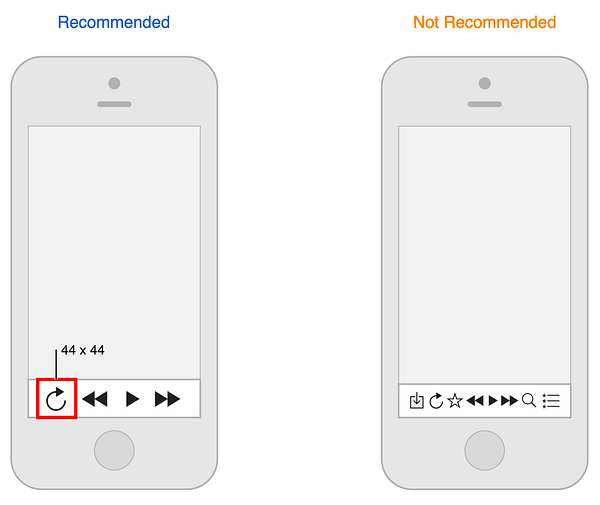
Does an interface respect users with physical constraints? Are click targets large enough and intuitive to provide easy use?
- Large fingers
- Challenging environment (like a bar top, store checkout, food cart, space shuttle, etc.)
First-Time User
Is an application still easily useable by first-time visitors? Many designers get fatigued while creating their interfaces and completely overlook the fact that the unconditioned visitor will be confused by how their interface has evolved.
- Does the workflow of an application cater to unconditioned users
- Does an application require them to ‘learn’ what icons mean?
- Does an application provide inline explanation for interface elements?
Screen Size
Does an application respond effectively to the visitor’s screen size? Is an interface easily useable on the following:
- 13” Laptop
- Phone
- Tablet
Touch
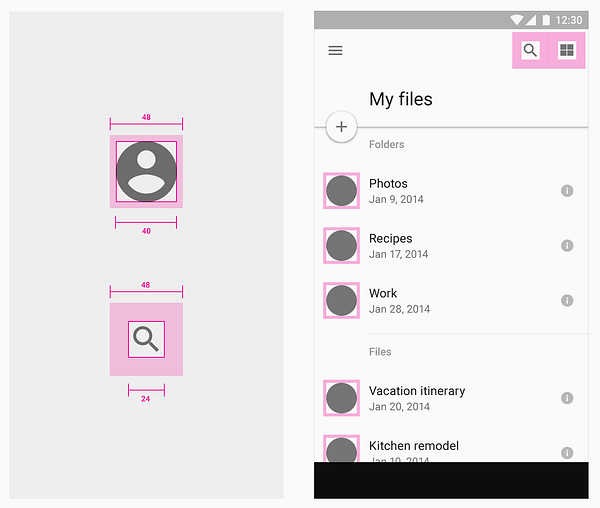
Does a design provide enough padding on elements for touch devices?
- Apple recommends 44px minimum container size for a touch element
- Google recommends 48px